

NetApp, a leader in intelligent data infrastructure, has officially unveiled the NetApp Novus. It is a breakthrough scale-out storage architecture designed specifically for the new era of artificial intelligence, sovereign AI providers, hyperscalers, and large enterprises building huge AI factories.
The novelty comes with a bold promise: to bring the fastest storage on the planet and remove the biggest bottleneck of today's infrastructure – the starvation of graphics processing units (GPUs) for data.
A Problem That Costs Millions: When Expensive GPUs Wait for Data
In modern data centers, thousands of connected GPUs are the most expensive item. However, they only generate value when they are actually working – whether it's training models, debugging, or running advanced AI applications. Traditional storage systems are hitting their hardware ceilings. When operators try to exceed the limit by connecting multiple separate systems, they create isolated "data islands". Infrastructure teams then have to deal with where the data lives, how to balance the load and constantly reconnect (remount) storage. The result? GPUs remain unused, consume expensive energy, and only generate waste heat instead of calculations.
Solution: Separating metadata from the data itself
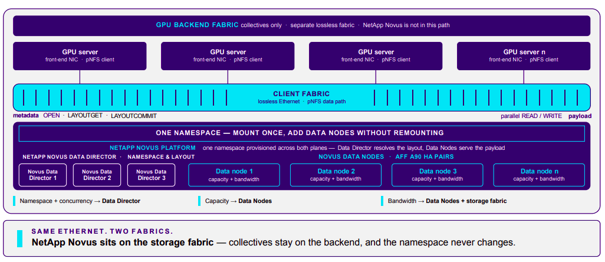
NetApp Novus is changing this problem from the ground up with a disaggregated metadata architecture. Novus completely separates the metadata coordination layer from the data movement itself:
- NetApp Novus Data Director (metadata server) records the distribution of data across storage and passes the information directly to the GPU client.
- It is then pulled out of the way, and the GPU node reads and writes the data directly to the storage layer without having to go back through metadata for each operation.
The data layer itself runs on the proven NetApp ONTAP® system (in the initial phase on NetApp AFF A90 systems). This approach allows for a linear increase in performance. Adding a new storage system immediately increases both the capacity and throughput of the common "pool", while the metadata layer scales independently of its own axis. Everything works under one common namespace (Single Namespace), which means no more fragmentation and the need for constant remounting.
No special drivers or client-side changes
A huge advantage for operators is the deployment without complications. NetApp Novus communicates with GPU nodes through the standard NFSv4.2 and pNFS Flex Files network protocols that most businesses already use. It also supports features like nconnect for multiple connection throughput and GPUDirect Storage (GDS), which allows direct data transfer between storage and GPU memory by completely bypassing the CPU. NetApp Novus thus behaves like a classic NFS repository for which every server is already ready.
Key benefits:
- Maximum GPU productivity: It eliminates data downtime, transforming idle time of processors into productive calculations and billable hours.
- Zettabyte scaling without fragmentation: It allows you to expand performance under one namespace.
- Energy and operational efficiency: The software-defined architecture saves space and electricity, as there is no need to oversize the hardware just because of the limitations of traditional controllers.
- Safe multitenance and QoS: It allows you to securely isolate multiple tenants on a single system, offers tenant-level encryption and advanced access control for both humans and autonomous AI agents.
The future of software-defined storage
The current delivery model combines a dedicated pNFS infrastructure with data nodes built on NetApp AFF A90 HA pairs. In the future, however, NetApp plans to further expand the Novus architecture and offer fully software-defined capabilities, where both metadata and data services will be able to run on certified third-party hardware. With the NetApp Novus architecture, businesses gain a powerful tool to make their largest investment in AI infrastructure generate real results, tokens, and competitive advantage instead of heat.