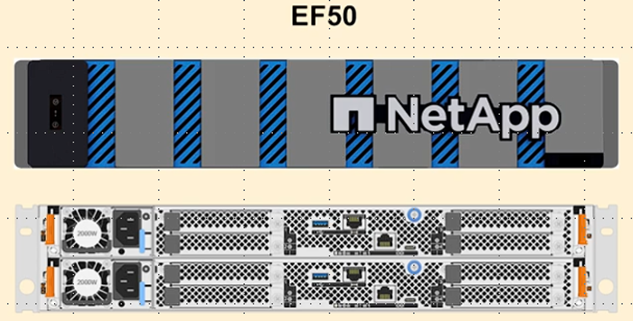
Another important change concerns the management of the EF50/EF80. On the rear side, there are no longer two RJ45 management ports on each controller, as has been typical for the entire E/EF series for many years. Instead, the entire management system has been replaced with a BMC (Baseboard Management Controller), just like the one used in NetApp AFF/FAS storage systems.
The new EF50/EF80 models also require a special card to be installed in slot 4, which is used for internal NVRAM mirroring between controllers. For this purpose, a 100Gb NVMe/RoCE HIC is used, although in some cases the card can be upgraded to a 200Gb NVMe/RoCE HIC. This new approach completely replaces the previously used internal PCIe Non-Transparent Bridging, which served as a high‑speed, low‑latency link for NVRAM mirroring and HA (High Availability) communication between controllers (NetApp AFF C30/60 uses a card in slot 4 for cluster/HA connectivity).
The remaining card slots (slots 1 to 3) can be populated with HICs (Host Interface Cards) for host connectivity, with the limitation that all cards must be of the same type — the new EF50/EF80 systems must still operate using only a single protocol.
Currently supported cards and protocols include:
- EF50 — four‑port 64Gb FC card supporting FC and NVMe/FC
- EF80 — four‑port 64Gb FC card supporting FC and NVMe/FC
or
- EF80 — dual‑port 200Gb Ethernet or InfiniBand card supporting NVMe/RoCE and NVMe/IB
Future plans include support for a dual‑port 100Gb Ethernet card for NVMe/RoCE and NVMe/IB, and a four‑port 25Gb Ethernet card for iSCSI.
In the future, slot 3 will also support a SAS card for connecting expansion disk shelves. NetApp EF50/EF80 storage arrays do not support synchronous or asynchronous data replication.
For now, EF50/EF80 arrays can be equipped with up to 24 internal NVMe drives. Available capacities include 3.8TB, 7.6TB, and 15.3TB, as well as high‑capacity 30TB/60TB drives. High‑capacity 30TB/60TB drives must not be mixed with smaller‑capacity drives in the same array. Another important change concerns RAID group usage. While lower‑capacity drives (3.8TB, 7.6TB, 15.3TB) require a minimum of six drives and still support traditional RAID groups, high‑capacity drives require a minimum of twelve drives. This is because 30TB/60TB drives always require DDP. Additionally, if the array is populated with high‑capacity drives, the operating system automatically creates a single disk pool (DDP) on first boot. If the array contains fewer than 20 high‑capacity drives, a standard DDP (8+2) is created; if it contains 20 or more, the system uses a more efficient DDP (16+2), reducing parity overhead from 20% to 11.1%. Of course, if the administrator needs a different RAID configuration, these automatically created DDPs can be deleted.
The new generation of NetApp EF Series storage systems is designed to support the highest‑performance workloads at scale. Deploying EF50 and EF80 arrays helps enterprises and cloud storage providers meet the growing demands of artificial intelligence (AI), high‑performance computing (HPC), and transactional databases, including emerging use cases such as sovereign AI clouds and AI‑driven manufacturing. When combined with high‑performance parallel file systems such as Lustre or BeeGFS, the new EF50 and EF80 systems accelerate HPC simulations and keep GPUs fully utilized thanks to high‑performance storage. This helps organizations unlock new values and competitive advantage at the right price. Customers — from modern cloud solution providers powering AI innovation to film studios managing massive media libraries — gain not only performance and scalability but also robust security measures to protect sensitive information and prevent data loss.